
How to annotate in Argument Analysis?
‘[Bearded Man with Magnifying Glass Examining a Manuscript]’ by Antoine-Samuel Adam-Salomon (French, La Ferté-sous-Jouarre 1811–1881 Paris)
When you sit down ready to read your text or begin planning your Argument Analysis essay, it can feel overwhelming to figure out where to start. With our three-level approach, your annotations are about to level up. This particular level of detail is most useful in practice pieces where you can take your time to unpack everything. With more practice, these four levels will come more naturally and can be shortened to be viable in the 5 minutes you allocated to planning in SAC or exam conditions.
In this resource, we will be looking at VCAA’s 2023 Exam Argument Analysis Text, which can be found here.
LEVEL 1 - THE BACKGROUND:
At this level, you consider the information from the background to better understand the whole text and the context in which it exists.
Once you read the background information, it is time to see what information you can glean to approach your understanding of the text better and write your introduction. Typically, information such as the author’s name, the form, the source and the issue is outlined in the background information. Let’s have a look at VCAA’s 2023 Exam text and see what we can learn:
The Narrow Valley region comprises small rural towns that border a large regional city. A group of young musicians who live in Narrow Valley have decided they want more opportunities to perform in their area. The group has written an open letter to the Narrow Valley community, which has been published on social media and in the local newspaper. In addition, copies have been displayed in shops and businesses. The following text is this open letter with images added by the young musicians.
INTRO COMPONENTS
(Details that are necessary to include in your introduction. Note: we will have to confirm these details in level 2)
Author: a group of young musicians who live in Narrow Valley
Form: open letter
Intention: decided they want more opportunities to perform in their area
Source: published on social media and in the local newspaper and displayed in shops and businesses
Audience: Narrow Valley community
OTHER INFORMATION
Location: Narrow Valley
comprises small rural towns that border a large regional city.
This tells us that there may be some competition for tourists, and opportunities may often be in the large regional city rather than in their small towns.
Hinted supporters: copies have been displayed in shops and businesses.
INSTRUCTIONAL INFORMATION
The following text is this open letter with images added by the young musicians. -
This one isn’t about context; it is simply clarifying that this background information is referencing the text and image that is on the following page.
In essence, the background information has both the standard introductory hints and outlines, but if you notice information that seems ‘random’, then it is probably serving a purpose to help you understand the context.
To sum up, before we read the text, we know the following:
The authors are a group of local young musicians who are writing an open letter to their community as they are interested in increasing opportunities for performances in the region, which they share with their audience. They have shared it in the local newspaper as well as shared it on social media, which indicates a wider net of people who may come across their open letter. They have also had local businesses agree to display their open letter, which will indicate that they already have some support from parts of the local community. We can potentially infer that these businesses may see some potential benefit for their own businesses if there is more opportunity to perform. Finally, the region may have some competition with the larger city that neighbours this community, which may or may not be felt by the locals (including the businesses).
LEVEL 2 - THE WHOLE TEXT:
At this level, you confirm what you have inferred from the background information through reading the whole text.
Taking what we know from that background information, we then go to the whole text and do our initial read-through. Our goal in this read-through is to clarify the introduction information that we may have gleaned from the background information.
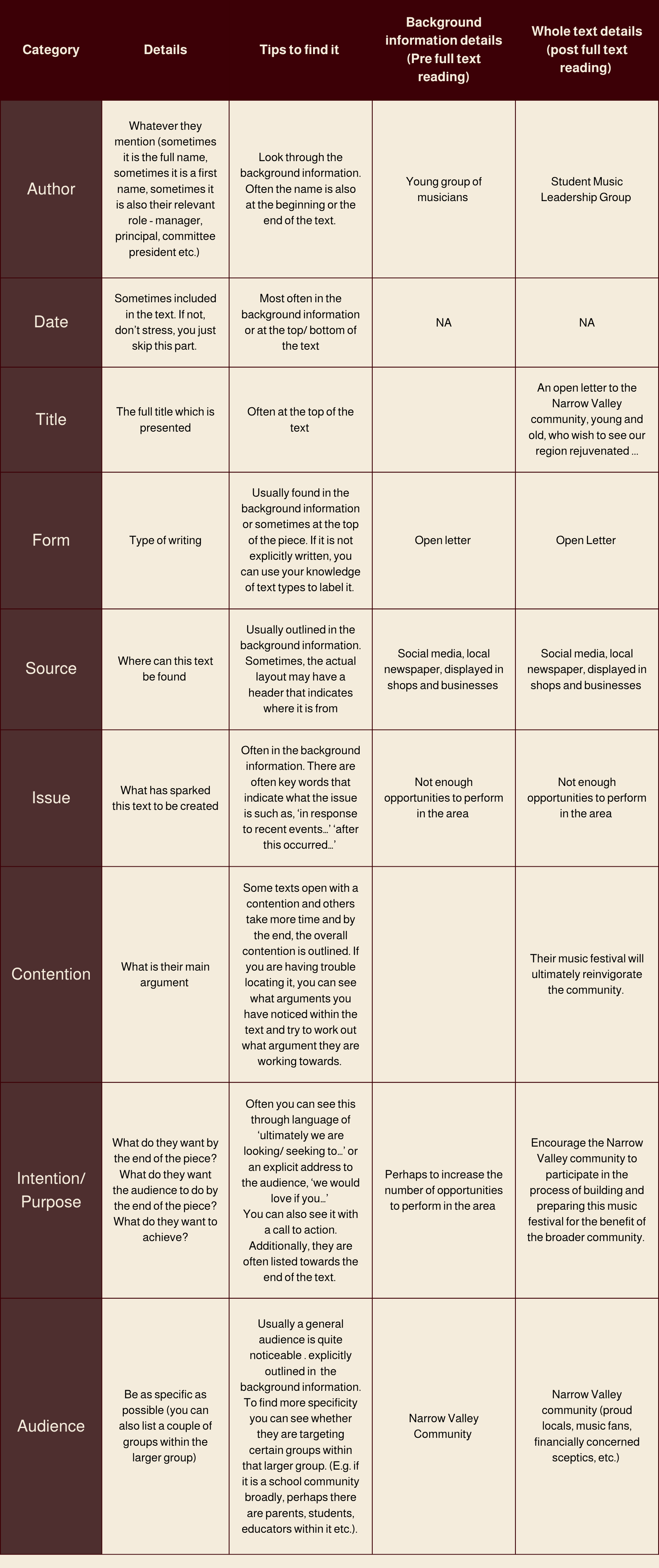
Now that that is complete and we have gleaned the larger overarching components, the next stage is working out the arguments and sections of the text. There are two stages for this.
Stage 1 - Understanding each paragraph
Taking what you know about the overall contention, you read each paragraph of the piece and outline what you think the function of it is. In other words, ask yourself, what are the authors attempting to establish in this paragraph? Some of the things that it could be:
Introducing an argument
Presenting the authors in a particular way
Framing the issue in a particular way
Arguing a rebuttal
Establishing a connection with the audience
Let’s look at the first paragraph of the 2023 VCAA exam:
Please allow us to introduce ourselves!
We are a growing group of high-school music students, teachers and mentors from the five Narrow Valley secondary colleges. We are eager to seize opportunities to bring dynamic and long-overdue changes to our region through an inclusive, youth-driven, energetic and shiny new music festival. Our festival will provide a space for all budding musicians, regardless of age and abilities, tastes and styles to come together and enjoy music.
This one has a bit of a hint, notice the opening line: ‘allow us to introduce ourselves!’ But we can take it further to see what they are saying about themselves. To help, look at some of the descriptions they are providing and how each sentence develops our understanding of who they are presenting themselves to be. In brief, this paragraph introduces the author as a group of young musicians who aim to benefit the broader community through their festival. The purpose of this paragraph is to frame themselves as a fresh, young group that will help bring those things to the community.
Now let’s look at a later paragraph of the same 2023 VCAA exam:
Few music festivals enjoy the geographical advantages that our region offers. We have a natural amphitheatre overlooking the valley, which could provide not only perfect acoustics but also a stunning backdrop for performances, particularly at twilight. Imagine this cathedral-esque space with the surrounding trees lit up for an evening performance, casting light and shadow on our home-grown superstars. Imagine the sounds of melodic folk tunes wafting across the valley, of hard rock and metal exploding into the night, or the sounds of jazz sizzling under the summer sunset.
Again, in this case, our first sentence is giving us a little hint; they are trying to highlight the ‘advantages’ of the region. Reading through the rest of the paragraph, we see a consistent pairing between musical performances and the natural advantages of the Narrow Valley region. From this, we can infer that they are trying to establish, or argue, that the natural region is a perfect and complementary fit for the music festival, which will highlight these features for others to enjoy.
Stage 2 - Grouping the paragraphs
Now that you have gone through and written some brief annotations (or mental notes) for what each paragraph is doing, it is time to group them.
In reality, there are many arguments and ways to split the text, but we have to be realistic given the time constraints we are under. VCAA’s Examiner’s Reports have also consistently outlined that “Students were not expected to identify each stage of the argument in minute detail,” (2025) and that they “were not expected to laboriously identify and discuss every element. Indeed, to do so within the time constraints would have been impossible,” (2024). So free yourself from the expectation to cover everything.
Now that we have that out of the way, let’s talk about grouping arguments. My favourite way of doing it is starting from the top of the text and with each paragraph asking myself, does this work best grouped with the paragraph above or the paragraph below? Then I colour-code them or draw a line next to the paragraphs that I think should be grouped. I usually look for things that they have in common in terms of function and argument.
Let’s look at the first few paragraphs of the 2023 VCAA exam text:
Please allow us to introduce ourselves!
We are a growing group of high-school music students, teachers and mentors from the five Narrow Valley secondary colleges. We are eager to seize opportunities to bring dynamic and long-overdue changes to our region through an inclusive, youth-driven, energetic and shiny new music festival. Our festival will provide a space for all budding musicians, regardless of age and abilities, tastes and styles to come together and enjoy music.
Our passion, talents and all-encompassing abilities enable us to experiment with, explore and master all types of music, including rock, pop, opera, hip-hop (to name just a few), which are all played by our various orchestras, ensembles and solo artists. We celebrate diversity in our local region and already have thousands of followers on social media, who are sharing our endeavours every day.
‘What?’, we hear you say. ‘An unrelenting cacophony disrupting the peace and quiet of our streets? Corrupting the impressionable? Shattering windows? Driving the dogs, cats and budgerigars crazy? What type of music did you say? Another music festival? The cost? And ... what about our Gorgeous Gardens Festival?’
The first one, as we said earlier, is focusing on introducing the authors and their plan. The second one focuses on their values as a group, as well as the types of musical involvement they have. The third one is focusing on anticipating community disagreement, particularly the potential clash with the current garden festival. Given this, I would group the first two paragraphs together, and the third paragraph would begin a new group.
Looking at the VCAA 2023 piece, here is one way you can group it:
An open letter to the Narrow Valley community, young and old, who wish to see our region rejuvenated ...
Please allow us to introduce ourselves!
We are a growing group of high-school music students, teachers and mentors from the five Narrow Valley secondary colleges. We are eager to seize opportunities to bring dynamic and long-overdue changes to our region through an inclusive, youth-driven, energetic and shiny new music festival. Our festival will provide a space for all budding musicians, regardless of age and abilities, tastes and styles to come together and enjoy music.
Our passion, talents and all-encompassing abilities enable us to experiment with, explore and master all types of music, including rock, pop, opera, hip-hop (to name just a few), which are all played by our various orchestras, ensembles and solo artists. We celebrate diversity in our local region and already have thousands of followers on social media, who are sharing our endeavours every day.
‘What?’, we hear you say. ‘An unrelenting cacophony disrupting the peace and quiet of our streets? Corrupting the impressionable? Shattering windows? Driving the dogs, cats and budgerigars crazy? What type of music did you say? Another music festival? The cost? And ... what about our Gorgeous Gardens Festival?’
Yes. What about our garden festival? Who doesn’t love a garden? Like music, gardens never fail to nourish the soul. However, our garden festival is tired. The number of visitors is dwindling – fast. Council data shows that the visitor numbers have dropped by 50 per cent over the past five years and it can only be expected that this trend will continue if we don’t plant some new ideas. With a decline of those proportions, the income from the festival is dwindling dangerously, too. It’s time for a change in tempo and style!

For generations, the same Gorgeous Gardens organising committee has done a remarkable job of planning and hosting this event – planting and replanting – but we now need some companion planting. Consider our proposed music festival as ‘festival fertiliser’ that will re-germinate interest and energy in our regional towns, otherwise stagnation will fully set in and we will end up in the compost bin.
Few music festivals enjoy the geographical advantages that our region offers. We have a natural amphitheatre overlooking the valley, which could provide not only perfect acoustics but also a stunning backdrop for performances, particularly at twilight. Imagine this cathedral-esque space with the surrounding trees lit up for an evening performance, casting light and shadow on our home-grown superstars. Imagine the sounds of melodic folk tunes wafting across the valley, of hard rock and metal exploding into the night, or the sounds of jazz sizzling under the summer sunset.
Like all semi-rural areas, we have buildings that have been standing silent and empty for a long time, including old town halls that could provide brilliant spaces for lessons, workshops and jamming. Our towns can proudly boast that our spaces are accessible to people of all abilities, so musicians and audiences alike can fully enjoy the festival offerings wherever they are staged. The district’s gardens could be opened for a different purpose – not just for admiration but also for musical events. Rock with your roses or mix some Mozart among the marigolds. Dare to put some tubas with your tubers! Melodious offshoots will enrich your world!

We know that our Narrow Valley region has seen some tough economic times lately and it might seem that a music festival is a frivolous waste of money. However, we see it as an opportunity to establish innovative partnerships with regional businesses – including fresh food producers, cafes and delicatessens, local artisans and artists – as one solution to overcome financial concerns. Our student bodies don’t just include musicians who can be involved but also media students, foodies, technology gurus and writers. We are confident that we can entice visitors, tourists and music lovers from far and wide to stay, eat and explore. We can see only increased prosperity for our region.
Imagine, too, how a visitor to our festival will see new musicians not in the cutthroat world of television talent shows but against the wholesome natural backdrops and the quaint historic buildings that abound in our regional towns. Visitors will eat fresh produce made into delicious meals and buy local. Visitors, residents and local businesses will all be much richer, and not just financially!
We are the youth of our region. Younger voices need to be heard so that our communities can find new energy, new purpose and new perspectives. It is time for generational change. We have talents that deserve to be seen and appreciated and nurtured – and not just on social media. Let’s share our triumphs. Let’s share our aspirations. Let’s provide opportunities for all.
We invite you, the residents of the Narrow Valley region, to our initial meeting, next Tuesday, in the Narrow Valley Botanical Gardens. The meeting will be followed by a performance by the Narrow Valley North College band. Please bring your ideas, your energy and even any concerns, so that we can begin our shared journey towards a new, prosperous future through our state-of-the-art music festival.
Yours, in harmony,
The Student Music Leadership Group, Narrow Valley
Sections
The author’s characterisation of themselves and their broader group
The benefits of the new festival (particularly through assisting the declining current Garden festival)
The complementary nature of the region with the festival itself
The economic benefits of the festival (for both locals and businesses)
Call to action to accept and contribute to the youthful regeneration of the region through the festival
These sections can now function as your body paragraphs, as ‘a more effective level of analysis saw responses that used the sequencing of ideas to logically divide their analysis.” (VCAA Examiner’s Report, 2023).
LEVEL 3 - WITHIN THE TEXT:
At this level, you highlight the language choices that are used to bolster the ideas that separate each section.
Within each section, read through the text again and pick out the words/ phrasing that are used to hold up the argument.
For example:
Section 2: The benefits of the new festival (particularly through assisting the declining current Garden festival)
Yes. What about our garden festival? Who doesn’t love a garden? Like music, gardens never fail to nourish the soul. However, our garden festival is tired. The number of visitors is dwindling – fast. Council data shows that the visitor numbers have dropped by 50 per cent over the past five years and it can only be expected that this trend will continue if we don’t plant some new ideas. With a decline of those proportions, the income from the festival is dwindling dangerously, too. It’s time for a change in tempo and style!
For generations, the same Gorgeous Gardens organising committee has done a remarkable job of planning and hosting this event – planting and replanting – but we now need some companion planting. Consider our proposed music festival as ‘festival fertiliser’ that will re-germinate interest and energy in our regional towns, otherwise stagnation will fully set in and we will end up in the compost bin.
Here, there are quite a few different words and phrases that all link to this broad idea that we have outlined, but within it, we are seeing some different approaches:
→ The dangers of the current approach to the gardens festival
Tired
Number of visitors is dwindling
Dropped by 50 per cent
Dangerously
Stagnation
→ Praising the efforts of those who are involved in that garden festival
Who doesn’t love a garden?
Gardens never fail to nourish the soul
Remarkable job
→ The music festival as a solution to help the garden festival
Plant some new ideas
It’s time for a change in tempo and style!
Companion planting
‘Festival fertiliser’
There is obviously not enough time to analyse all those different elements, so we need to be selective. Since we have separated a few building ideas that lead to the overall section’s idea and purpose, we can select one or two elements from each idea and analyse those so that we can ensure we are analysing as many of the steps of the argument development as possible. You may choose one per section or potentially pair some, such as ‘tired’ and ‘stagnation’ or ‘remarkable job and ‘nourish the soul’ or ‘companion planting’ and ‘festival fertiliser’. Nevertheless, this is up to you to pick what you think boosts the argument the most and what you feel comfortable analysing.
Remember, you are analysing language choices, don’t just look out for recognisable persuasive techniques, think about the context specifically and what is working best for this section, within this broader argument for this audience and author. In the 2025 Examiner’s Report, VCAA outlined that ‘at [low - middle] skill level, responses, often stressed very familiar linguistic devices… and demonstrated general analysis rather than exploring how the specific example contributed towards persuasion.’
In essence, the goal is not to spot a technique you can label but rather to spot the language choices that elevate the argument within this specific text’s context.
Now that you have completed all three levels, it is time to get to writing your essay!
