
Development of Argument
Have you heard your teachers mention this concept of ‘Development of Argument’? Are you unsure of what it really is and how to show it in your Argument Analysis essays? Look no further, we are going to break it down together.
Study Design
This term was added to the current study design that began in 2023 (For Units 1/2 and 2024 for Units 3/4), where one of the key skills in Year 12 is the ability to ‘identify and analyse, and apply: the intent and logical development of an argument’ (2024 English/ EAL Study Design, p.32, VCAA). It has also been added to the Assessment Criteria (pg.4) for the end-of-year written examination for essays scoring 8+, whereby those essays ‘demonstrate a thoughtful/ perceptive understanding of … the development of argument(s)...’ This doesn’t mean that students were not analysing this aspect in previous study designs, but rather it is now an explicit requirement of the upper part of the rubric.
Let’s break down the term
‘Development of Argument’ acknowledges a few different things:
Arguments aren’t static; they evolve across a text
Arguments are intentionally developed
Arguments are developed through various strategies
Arguments build upon each other, usually to a larger contention
Readers are taken on a journey across arguments
Using Oral Presentations to help
Now this Area of Study (Unit 4, Area of Study 2) covers both the oral presentation and the Argument Analysis essay, so we can look at what we know about creating an oral presentation and apply similar logic to reading someone else’s argument. When preparing your oral presentation, you typically begin with a well-established contention, supported by additional arguments. Let’s look at an example:
Contention: ‘Experiences are a better gift than objects.’
Supporting Arguments:
It allows you to spend more time together with the gift receiver
Memories last longer than objects
It can be a cost-effective choice with high value
All these supporting arguments build the reader's likelihood to align with the contention and whatever the intention/ purpose is. Some argumentative pieces will be clear with their contention immediately, while others will be more vague and establish their contention later. Nevertheless, the supporting arguments are building the contention, for example:
Beginning by reminding the readers of the value of spending time with loved ones
Continuing by tapping into memories and the emotional/ sentimental value of those moments
Leaning into the struggle of gift buying
Advocating for the gift of experiences and memories
Acknowledging the concern of cost, but offering cost-effective alternatives, whilst reiterating the meaning of memory over an object that will collect dust on a shelf.
By now, hopefully, we can see that arguments are journeys that the arguer is taking the reader/ listener on. We have some practice in this with the oral presentations, and I am sure that there has been a moment where you have had to convince someone of an idea or to come to an event that they cannot be bothered going to. The journey you take to try to convince them is what we are talking about. That is the development of an argument!
What does this mean for Argument Analysis?
We have created a visual that will help to conceptualise this component of Argument Analysis. You can download it here!
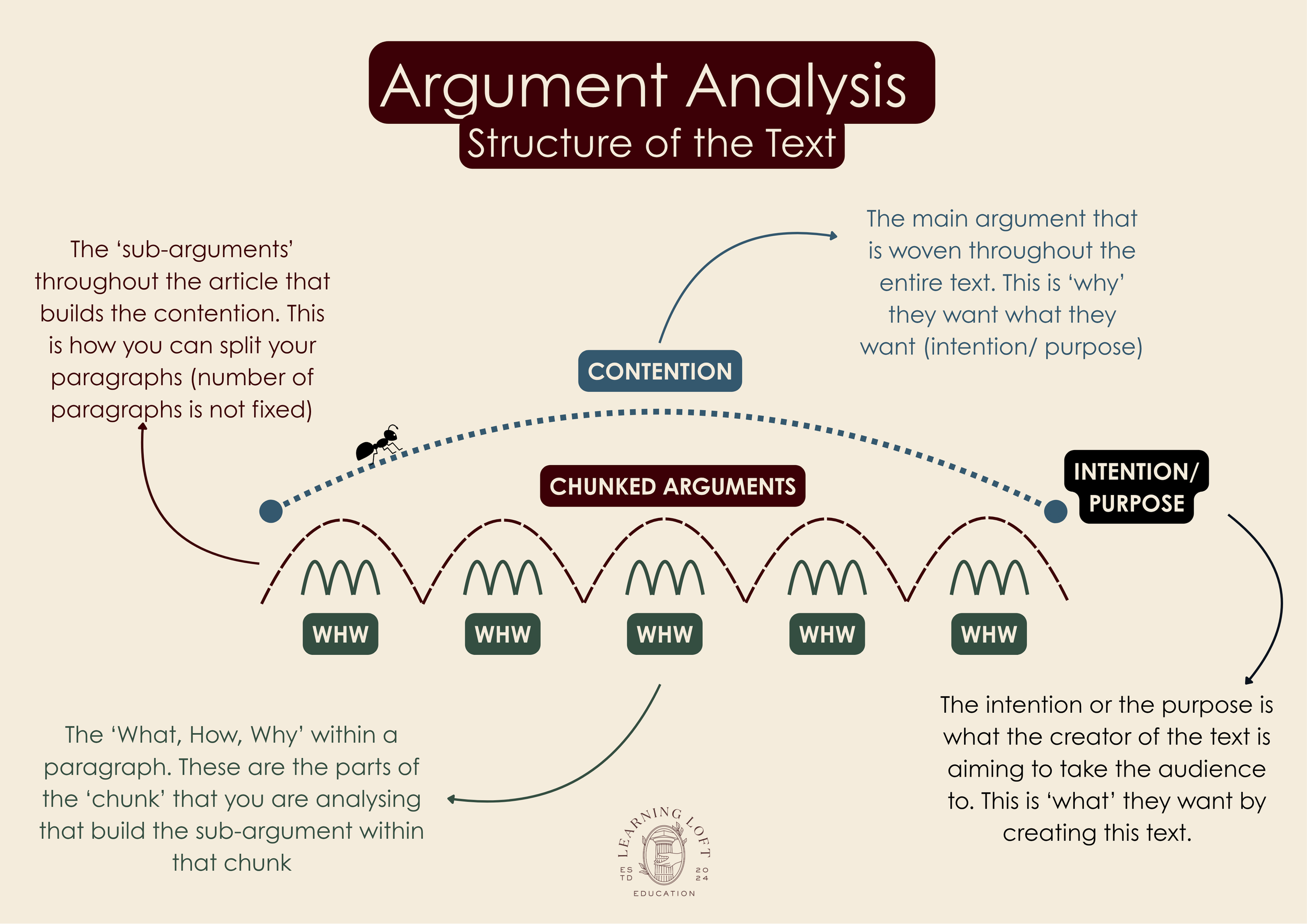
Using the visual above, let’s make this aspect of Argument Analysis more specific to VCAA.
As we’ve established, argumentative texts have a contention that the whole piece is aiming to convince the audience of (whether it is explicitly mentioned the whole time or not). Within the journey of the text are these aforementioned supporting arguments, which often need to be chunked (grouped to be analysed in your essay). These chunked arguments are the beams that support the bridge that is the contention, which allows the audience (our little ant friend) to walk across the piece comfortably towards the intention/ purpose of the piece. Now, typically, students are encouraged to split the text into parts (often 3, but to extend yourself, you can definitely aim for more), and one of the best ways to do this is by grouping the arguments that you see.
To support these arguments (which support the contention) are the various elements that you analyse through what is commonly called ‘what, how, why’ (this process has different names in different schools). Think of it as the bolts that secure the beams (chunked arguments), which hold up the bridge (contention), taking the audience to the intention/ purpose.
Writing Development of Argument Analysis
If you are aiming for 8+, you must include the development of an argument; however, if you are aiming for below 8, it is still great to try to include it, as it will boost the overall quality of your piece.
What you are looking to answer across your paragraph is, ‘how do the elements work together to build the argument which helps, in conjunction with the other arguments, to support the contention, to position the audience to fulfil the purpose/ intention of the piece?’ In other words, comment on the intersection between each of the three components.
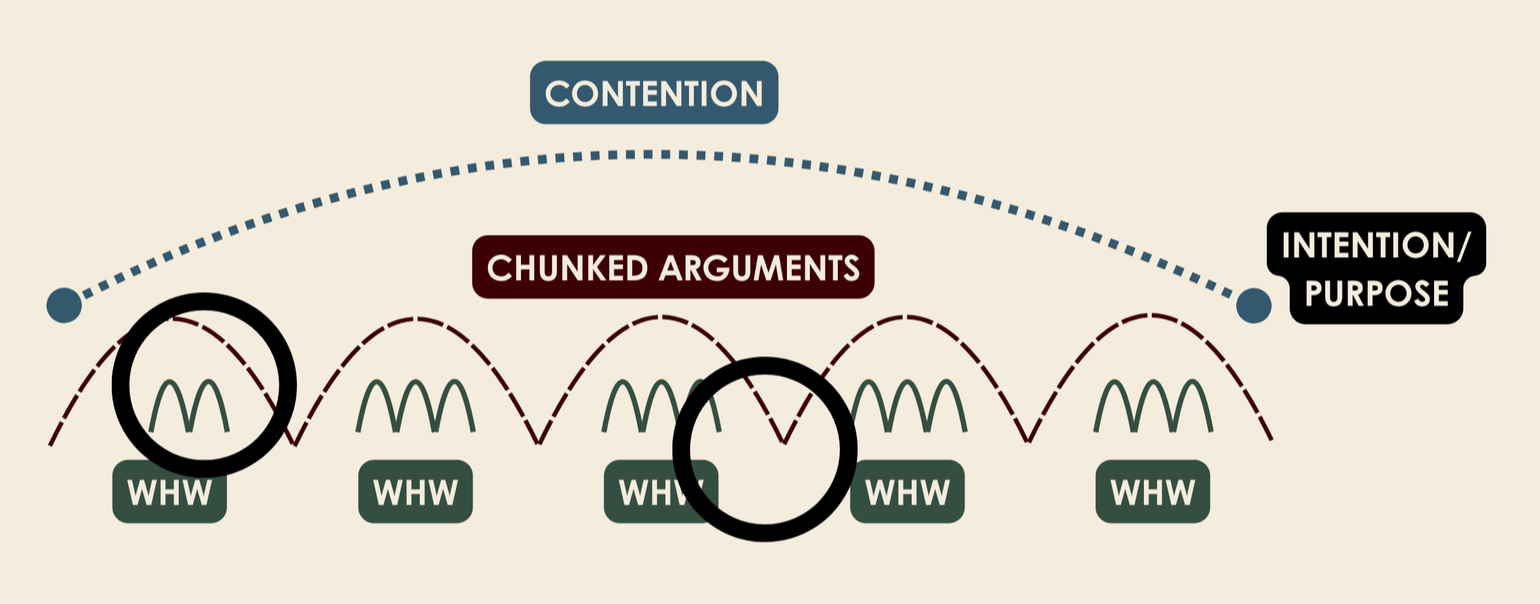
As for what it will look like in your essay, there are mixed opinions, and you will likely hear different things from different teachers, but what I have found works well is to include it in a sentence or two at the beginning of your paragraphs, either separately or with the topic sentence.
Some ways that you can do that are by using these sentence templates:
Building on (previous argument), the (author’s name) develops the reader’s understanding of (issue), in order to (current argument).
(Author’s name) continues by arguing (current argument) through capitalising on the established (argument 2), in an attempt to (position the audience)
What does VCAA say?
Looking at the 2024 VCE English external assessment report (pg. 38), we can see how one student analysed the argument’s construction:
Analysis of argument construction
Focusing on the way in which ideas were strategically sequenced in order to position the listener given the text’s context and audience
This response used linguistic cues to indicate the argument’s strategy.
BP1 ‘Before she forwards her contention, Gestalt first seeks to imbue her speech with an overwhelmingly hopeful and optimistic tone.’ ‘… Gestalt not only strives to build rapport between audience and speaker given their long-standing connection, but also construct an optimistic future …’; ‘Gestalt guides her listeners to view the gym as a facility worth protecting, thus …’
BP2 ‘Having established the current predicament threatening the livelihood of such a special cultural institution, Gestalt continues by attempting to present a partnership with ‘Long Live Lollies’ as the only viable solution.’
BP3 ‘[She] implores the audience to … focus not on the immediate, ostensible challenges, but the opportunities also presented …’; ‘Thus, Gestalt guides her listeners to view her proposal of a partnership with enthusiasm …’
BP4 ‘By suggesting that each listener’s vote carries a responsibility to represent those not present as well …’; ‘also allows Gestalt to nonetheless convey the need to embrace what might seem “uncomfortable” … as an opportunity to grow …’
We can see some keywords here that allow this student to convey that they are thinking analytically about the text and the development of argument:
Sequencing
‘Before’
‘First seeks to…’
‘Having established… continues …’
Connection between elements
‘Not only… but…’
‘Thus’
‘By…to’
Final Thoughts
Try to remember the analogy of a bridge with beams and bolts for the components of the text and try to comment on their interaction with each other.
BUT, it is more intuitive than you think - lean into your experiences of building your own arguments.
